

The Government has opened public consultation on two new packages aimed at updating New Zealand’s transport rules, focusing on everyday safety and reducing compliance costs for freight operators.
Transport Minister Chris Bishop says the changes are designed to address practical issues faced by families, drivers and trucking companies.
“For most New Zealanders, transport rules are not something they think about until they run into them,” Mr Bishop says.
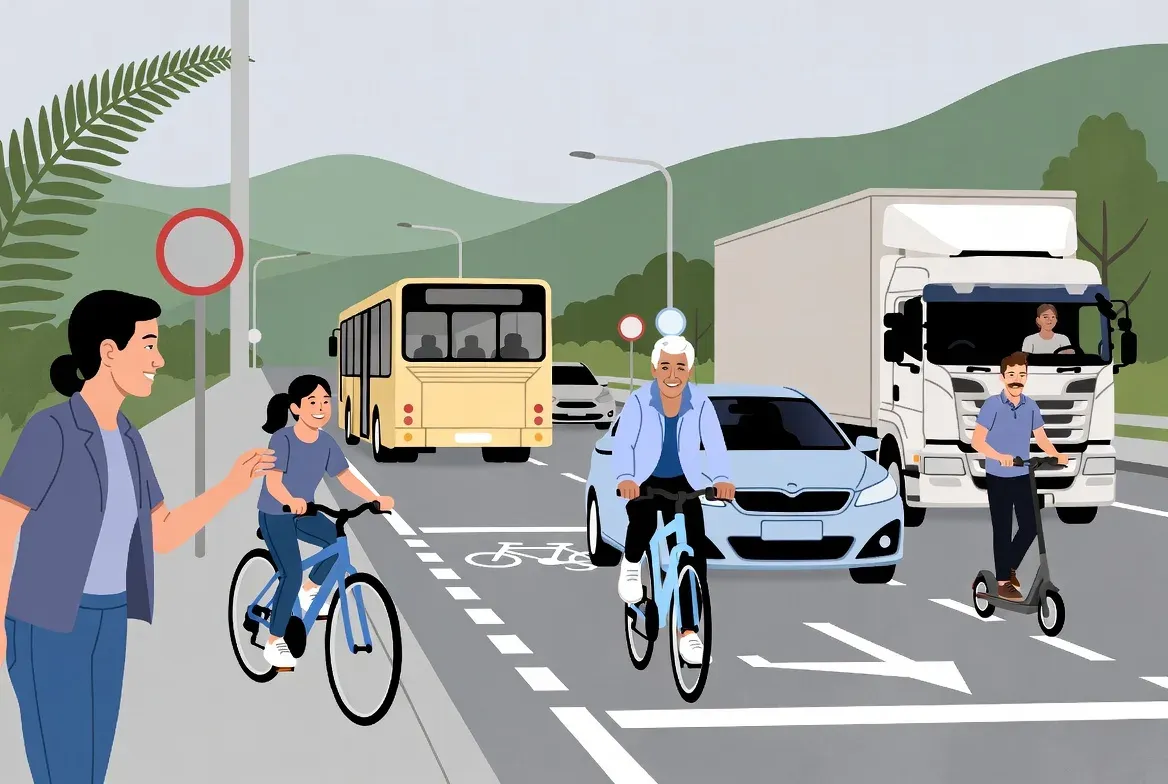
“It might be a parent unsure whether their 10-year-old is allowed to ride their bike on the footpath, a driver not clear how much space to give a cyclist, an e-scooter rider not sure if they can use the cycle lane, a bus stuck waiting to pull back into traffic, or a truck operator tied up in paperwork just to move an empty trailer between depots.
“We are fixing the basics by making sure the rules are clear, practical, and reflect how people actually use our roads every day. This is about safer school rides, smoother bus trips, clearer guidance for drivers, and fewer compliance headaches for truck operators.
“This is technical work, but it matters in the real world. It affects how parents teach their kids to ride bikes safely, how drivers pass cyclists or horses on rural roads, how buses pull out in traffic, and how truckies get freight from A to B.”
The first package centres on lane use and everyday road rules. Ministers are seeking feedback on five proposals designed to better reflect how people already travel and improve safety for cyclists, pedestrians, bus users and motorists.
Among the proposals is allowing children up to 12 years old to ride bikes on footpaths. A mandatory passing gap of between one and 1.5 metres, depending on the speed limit, is also suggested to give clearer guidance when motorists overtake cyclists and horse riders. Other measures would allow e-scooters in cycle lanes, require drivers travelling under 60 kilometres per hour to give way to buses pulling out from stops, and clarify signage rules for berm parking.
“Many children already ride on footpaths, although the current rule does not allow them to. Bringing the law into line with reality, with appropriate guidance and expectations around responsible riding, will help families make safer choices,” Mr Bishop says.
“I acknowledge some pedestrians, including older people and members of the disability community, may have concerns. Education and clear guidance will be important, and parents and caregivers will need to ensure children ride at safe speeds and give way to pedestrians.”
The second package focuses on heavy vehicles and freight. Proposed changes include easing permit requirements for moving empty High Productivity Motor Vehicle combinations, updating licence settings to support zero-emissions vehicles, making load pilot signage more practical, and providing overseas licence holders with clearer conversion pathways.
“Freight keeps our economy moving, and truck drivers are the backbone of our supply chains. We have heard clearly from operators that some of the current rules create unnecessary delays and costs without improving safety,” Mr Bishop says.
“These are practical, commonsense changes. They give operators more certainty to get on with their work, reduce compliance headaches, and support the transition to low-emissions vehicles, all while keeping safety front and centre.
“These two packages of proposals are just part of the wider Land Transport Rules Reform programme.
“Last year we reduced the frequency for vintage vehicles and private motorhomes needing to get a Warrant of Fitness or Certificate of Fitness, and in recent months we’ve consulted the public on also reducing WOF/COF frequency for light vehicles, simplifying heavy vehicle permitting, and potential safety requirements for vehicles entering the fleet. We’ll have more to say on those proposals soon.
“There’s still a lot more work to do on modernising New Zealand’s Land Transport Rules. We hear the freight and heavy vehicle sectors loud and clear when they tell us there are more changes they’d like to see, and policy work is underway to carefully consider those ideas.
“These changes are just a first step in commonsense reforms across New Zealand’s transport system. The Ministry of Transport and NZTA will build on the momentum of the programme by considering further reforms to Land Transport Rules, informed by issues that have been raised by industry and the public. There is also research underway to inform future work to enable more productive vehicles.
“We encourage parents, cyclists, bus users, disability advocates, truck drivers, transport operators, councils and everyday road users to have their say on the current proposals. Good rules are built on commonsense feedback from people who live by them.”
Consultation on both packages runs from 25 February to 25 March 2026. Submissions can be made through the NZTA website at nzta.govt.nz/laneuse and nzta.govt.nz/hvp-phase-2