
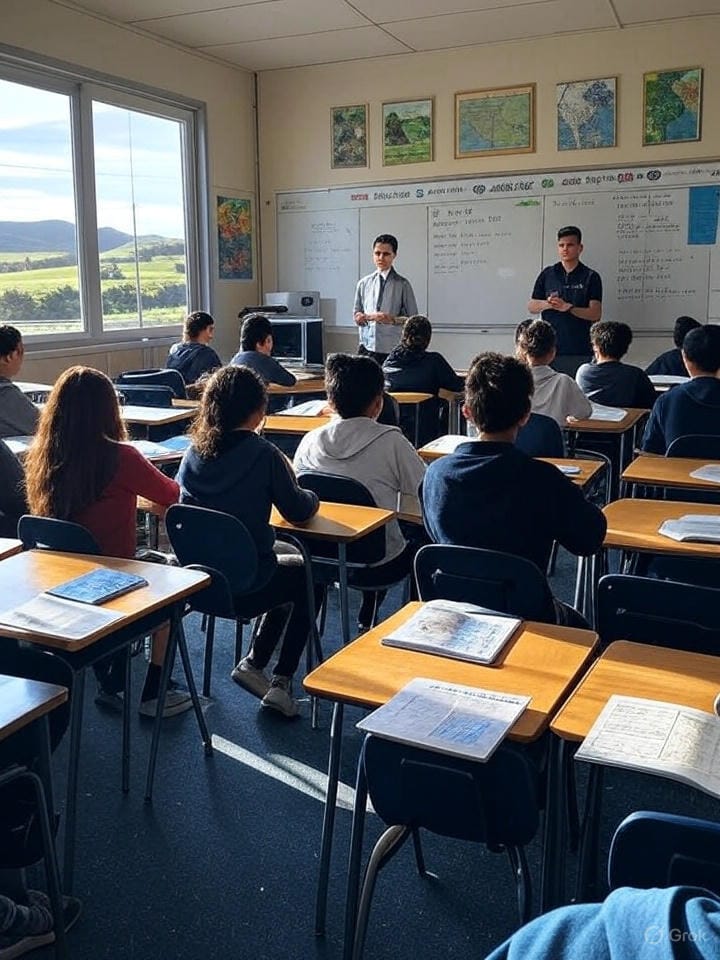

- ACT claims the new history curriculum removes political bias and restores educational balance
- David Seymour says the changes move students away from “victims-and-villains” historical framing
- Broader topics like Ancient Greece and Rome added to spark wider historical interest in students
New Zealand’s draft Year 1–10 school curriculum has been released, with major changes to the way history is taught, as part of the Government’s plan to deliver a more balanced and globally informed education system.
Education Minister Erica Stanford described the curriculum refresh as a significant milestone, marking the first full update of the national curriculum in nearly two decades. She said the changes aim to ensure every student has access to clear, consistent, and knowledge-rich learning.
ACT Leader David Seymour welcomed the release of the new draft, particularly the changes to the Aotearoa New Zealand’s Histories curriculum. He said it delivers on ACT’s coalition promise to remove political bias from the teaching of history.
“The school history curriculum will create citizens who know where they’re from, but also understand the world across the seas. No longer will it indoctrinate young people for political purposes, history education will be for the benefit of the children,” says ACT Leader David Seymour upon the release of the draft new school curriculum.
“School curricula should expand the mind, not some adults’ ideology,” says Mr Seymour. “The previous 'Aotearoa Histories' curriculum, introduced under Labour, drove a simplistic victims-and-villains narrative. Its so-called ‘big idea,’ that ‘Māori history is the foundational and continuous history of Aotearoa New Zealand,’ excluded most New Zealanders from the story. Its other ‘big ideas’ were not much better.
“The second ‘big idea’ that ‘Colonisation and settlement have been central to Aotearoa New Zealand's histories for the past 200 years’ set New Zealand up as a nation of victims and villains. The third idea, that ‘The course of Aotearoa New Zealand's histories has been shaped by the use of power’ only reinforced that idea.
“By the time the fourth ‘big idea’, ‘Relationships and connections between people and across boundaries have shaped the course of Aotearoa New Zealand's histories,’ came along, it was too late to expand young minds.
“I’m proud to say these dismal, divisive and overly political ‘big ideas’ are all gone.
“The relentlessly ideological and cynical history curriculum was turning kids off history. A review by the Education Review Office found children didn’t engage with history that was narrow and local. Yes, they wanted to know their own immediate past. They also wanted to be stimulated by ideas from afar that they might not otherwise engage with.
“The new history curriculum does that. Instead of gorging on a restricted diet of local history, students will now learn about Ancient Egypt, Rome, Greece, through to the Victorian Age. We are teaching young Kiwis to look outward and engage with a world that has always been connected and always will be.
“The new curriculum restores balance, and celebrates the positives in our history while inviting critical thinking. It teaches that we’re all descended from people who crossed oceans – whether in wakas, steamships, or Airbuses – to build a better life together at the bottom of the world.
“ACT has delivered a step away from politicised education, and a step toward a shared sense of citizenship based on common history, equal rights, and mutual respect.”
The new draft curriculum also includes updates across other subjects, including Science, the Arts, Technology, Health and Physical Education, and Learning Languages. Social Sciences now feature new strands on Civics and Society and Economic Activity, while a new Music Technology component has been added to The Arts.
The draft curriculum is open for feedback over the next six months from educators, schools, and the public. The final curriculum will be rolled out from 2027.
Highlights include:
- Social Sciences:History covers New Zealand and global history, exploring how people, places, and ideas connect and evolve over time. Students will learn about early explorers, settlers, and migration stories, the Treaty of Waitangi/Te Tiriti o Waitangi, and key civilisations and figures that have shaped societies and decision-making. New strands include Civics and Society and Economic Activity (which introduces financial education to build practical money and economic skills). Geography remains central, deepening an understanding of people and place.
- Science: spans the Natural World and Physical World so that students can explore, investigate and explain the world around them. It includes learning that celebrates prominent scientists, including New Zealanders, who have made influential discoveries or advances, relevant to the content being taught.
- Health & Physical Education: develops movement skills, teamwork, and wellbeing through sport, choreography, and the Relationships and Sexuality strand. A key change is compulsory consent education, ensuring every student can build safe, respectful relationships.
- The Arts: provides a structured pathway for creativity and expression, with a strong focus on indigenous art forms unique to New Zealand. A highlight is the new Music Technology strand, preparing students to create and produce sound across digital platforms. The curriculum provides opportunities for composition, design and creation across multiple art forms.
- Technology: focuses on design, innovation, and creation, helping students to solve problems and become capable creators and informed consumers. Learning includes circuits, coding, food technology, design ethics, and sustainable practices, with opportunities to work in both digital and “unplugged” environments.
- Learning Languages: offers structured progressions across thirteen languages in five groups, Pacific, Asian, European, te reo Māori, and NZ Sign Language, providing a clear pathway from novice to expert and allowing schools to tailor learn