
News
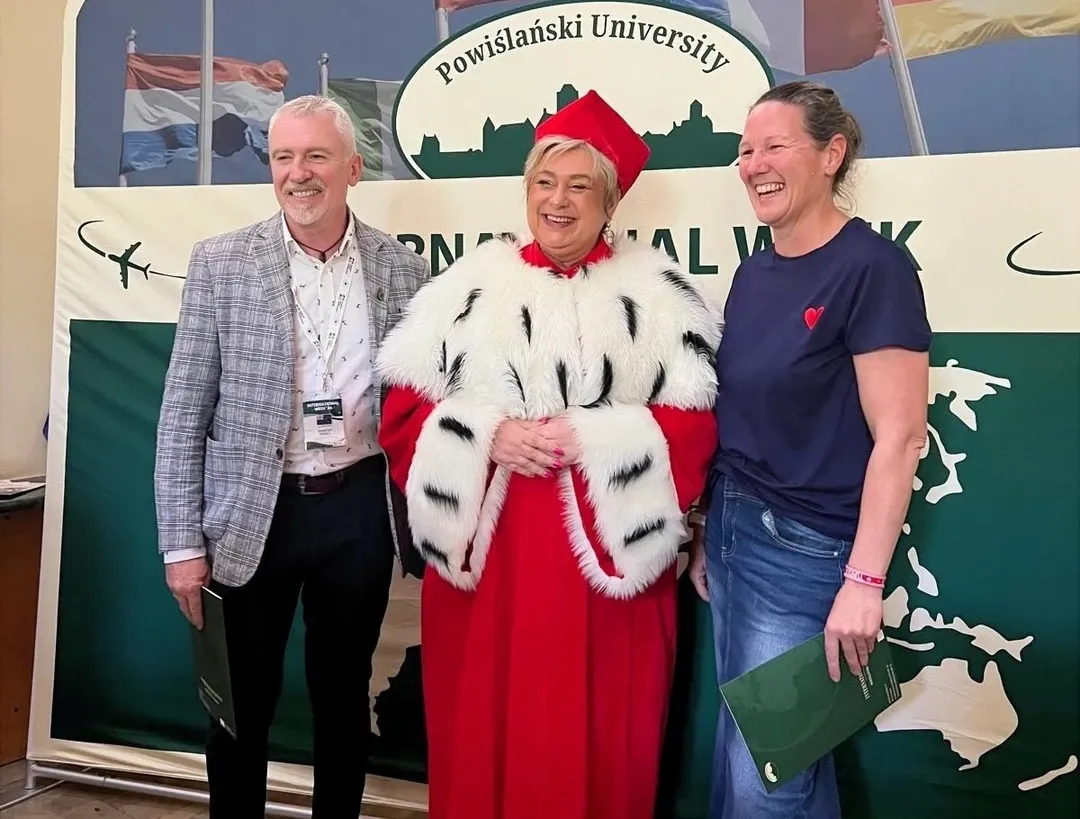
Two SIT staff spent a week in Poland this month building international partnerships — and came back with genuine interest in Southland as a study destination.
SIT nurse educator Marie Meyer and head of faculty Hamish Small travelled to Gdańsk from May 20 to 24 to attend the Powiślańska Academy of Applied Sciences International Week. More than 60 guests from 25-plus countries attended, backed by the European Union's Erasmus+ education programme.
For Meyer, the standout moment was stepping in front of a Polish university classroom. "This provided valuable insight into different teaching approaches and encouraged open discussions about nursing education and healthcare systems in Poland, New Zealand, and other participating countries," she said.
"It was interesting to see both the differences in how healthcare is delivered and the many common challenges faced across countries, including workforce pressures, an ageing population, and preparing students for increasingly complex healthcare environments."
The week ran in English throughout. "This made it easy to communicate, collaborate, and build relationships with participants from a wide range of countries," Meyer said.
SIT's Polish counterparts want more than just a bilateral relationship. "Our Polish partners also expressed a strong interest for us to introduce them to our wider international network (China and Australia), to create further opportunities in strengthening global partnerships and to explore future collaborations across nursing and business," Meyer said.
Small flagged strong appetite among European academics for Southland specifically. "Our visit to the Powiślańska Academy of Applied Sciences extends on SIT's growing European partnerships with significant interest in Southland, New Zealand, as a destination for Euro-based study abroad students, and continual collaboration for our staff globally," he said.
From the Polish side, the value was equally clear. Powiślańska Academy international affairs director and Erasmus+ coordinator Paulina Osuch said meeting the SIT pair went beyond what a prior visit to Invercargill by the university's rector had conveyed. "Although our Rector had previously shared valuable insights following her visit to SIT in September 2025, speaking directly with Marie and Hamish provided a much deeper understanding of New Zealand and its higher education environment," Osuch said.
She found the cultural as well as academic exchange worthwhile. "These conversations broadened our perspective and highlighted how international cooperation enables us to learn from different experiences and practices," Osuch said. The visit also sharpened the academy's appetite for deeper ties. "It reinforced the importance of building long-term international partnerships based on mutual understanding, knowledge exchange, and cultural appreciation," she said.
Deputy Erasmus+ coordinator Mateusz Grądzki said feedback from participants across the week was strong. "Having representatives from different parts of the world in one place allowed them not only to build new professional and personal connections, but also to look at education, teaching and international cooperation from perspectives different from their own," Grądzki said. "I think this is one of the greatest strengths of an International Week — it creates a space where people can learn from each other beyond their own institutions and national contexts, while at the same time establishing contacts that may lead to future cooperation."
Meyer also found time for the city itself — describing Gdańsk as a colourful, beautifully restored place. "Walking through the city provided an appreciation of its historical significance, from its communist-era influences to its impressive post-war reconstruction, making it a fascinating place to visit both professionally and personally," she said.