
News
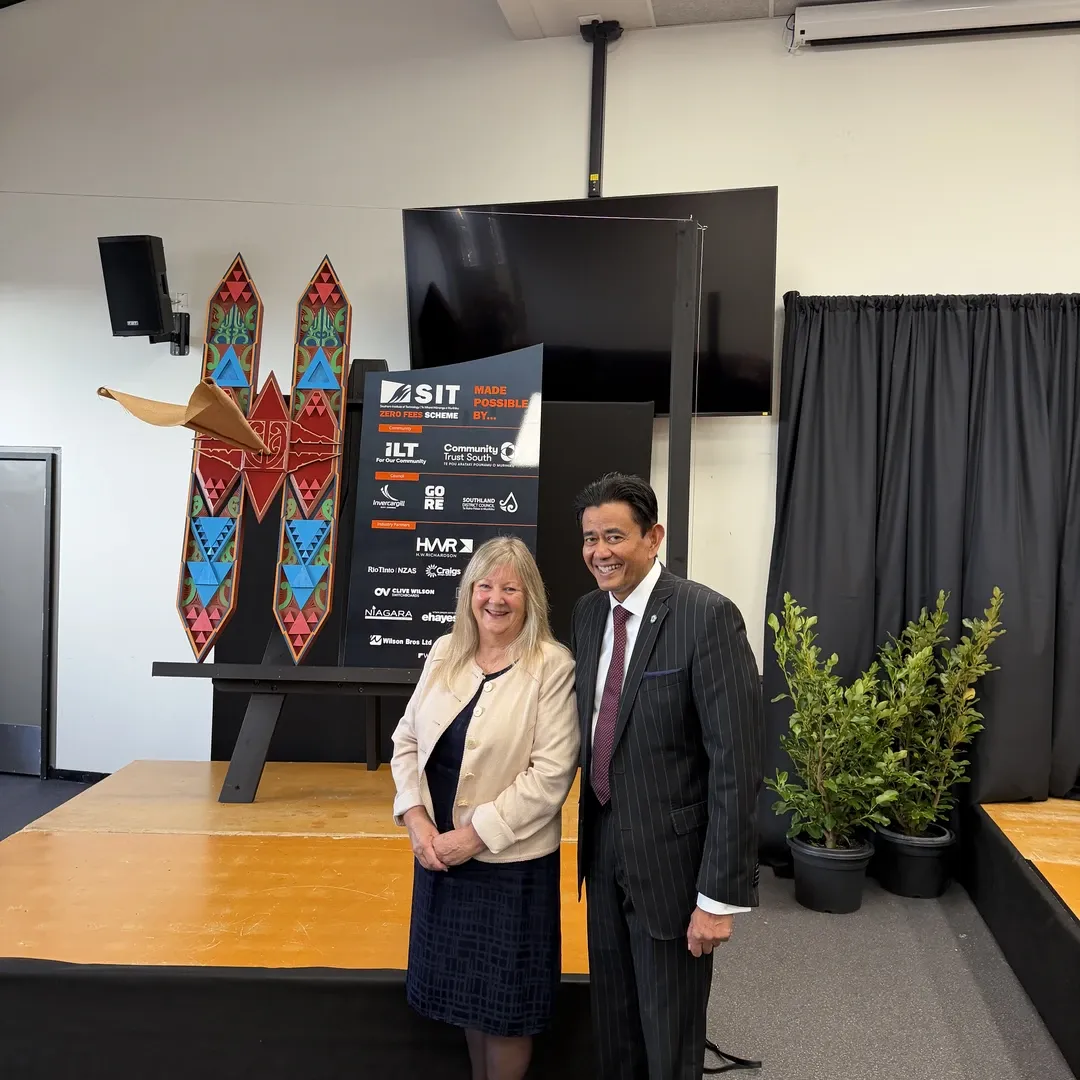
SIT's Zero Fees Scheme turns 25 this year, and the story of how it started still sounds like a gamble that nearly didn't happen.
Southern Institute of Technology held a celebration at Hansen Hall last Thursday to mark the milestone, bringing together community leaders, business partners, staff and students. The guest of honour was Tertiary Education Minister and Invercargill MP Penny Simmonds — who also happens to be the person who dreamed the scheme up in the first place.
Simmonds was a new SIT chief executive in 2000 when she attended a leadership course at Macquarie University in Sydney. Fees were the obvious barrier to tertiary education. She came home with an idea. She and then-CFO Bharat Guha ran the numbers.
The scheme's origin story has become local legend, but Simmonds told it again on Thursday. A community summit on Stewart Island. A napkin from the café near the church. The figures worked out over dinner, with enough red wine that everyone agreed it sounded reasonable. Everyone also agreed to keep quiet while SIT refined the plan.
That lasted until Monday. "Then Mayor Tim visited our sound engineering students and said, 'Won't it be great when you don't have to pay fees next year?'" Simmonds said. "The media went crazy and it went all over the place."
What followed was months of public debate — surveys, radio, daily newspaper coverage — before the scheme was approved. A group of Southland business leaders, including the late Bill Richardson, Owen Poole from Alliance and the late Fred Tulloch, scrutinised the budget in what Simmonds described as "a bit like a Dragon's Den for Burrett and I." They never went public with their verdict, but they wrote a letter to the funders confirming the business case was sound. That letter, kept private at their request, gave the funders the confidence to commit.
The community came through with $7.25 million over three years — from the ILT, the Community Trust, Invercargill City Council and Southland District Council, plus businesses including H&J Smiths and E Hayes.
Then came the moment of doubt. "There was a moment of reflection after the decision had been made to go ahead, when Mayor Tim and I looked at each other, and said, imagine if we make it zero fees and still no one wants to come here, it's going to be really embarrassing!" Simmonds said.
They needn't have worried. Enrolments jumped 46% in the first year and 29% in the second — a year ahead of the target timeline. Student numbers grew from roughly 1,000 equivalent full-time students to 3,000 in the first three years. An unexpected wave of students over 40 came back to retrain, particularly in IT and nursing.
Simmonds credited the late Sir Tim Shadbolt — who once had himself fired from a cannon to promote SIT — as a force of nature for the scheme. "He bought for us marketing that we could never have paid for," she said. "It was an exciting time; I don't think I'll ever have anything as dramatic in my life as that..."
Chair of the Southern Institute of Technology (SIT) Council Rex Chapman acknowledged the funders and the community's role. "The scheme has been widely credited with revitalising Invercargill and the region after it attracted thousands of students to the South," Chapman said, noting that EFTS grew from 1,000 to 3,000 in those first three years. He also acknowledged SIT's return to independence from Te Pūkenga from January 1 this year, which he said had given the institute "greater freedom to innovate and be more responsive to the needs of our students, the community and, importantly, local industry."
Current CEO Bharat Guha — Simmonds' numbers man back in 2000 — now leads the institution he helped build. His aim is to lock the scheme in permanently. "Our goal is to ensure SIT Zero Fees remains for the next 25 years and that Southland has full access to it; that's what we're here for," Guha said. "To our council, staff, students, industry partners and members of the community, thank you for making SIT such a special place. We are committed to the region, and we are committed to growing the region."
Since 2001, the scheme has given an estimated 420,000 New Zealanders a debt-free qualification. That's the number on the napkin, made real.