Staff at Southland satellite company SpaceOps say they would walk off the job if the firm took on military contracts — but its founder has no intention of writing a policy to rule that out.
SpaceOps chief executive Robin McNeill, recipient of the 2024 Prime Minister's Space Prize for Professional Excellence, confirmed there are no formal rules barring military work, despite the company being a subsidiary of regional development agency Great South.
"We've got enough other things to do without spending ages developing a policy that we don't need," McNeill said.
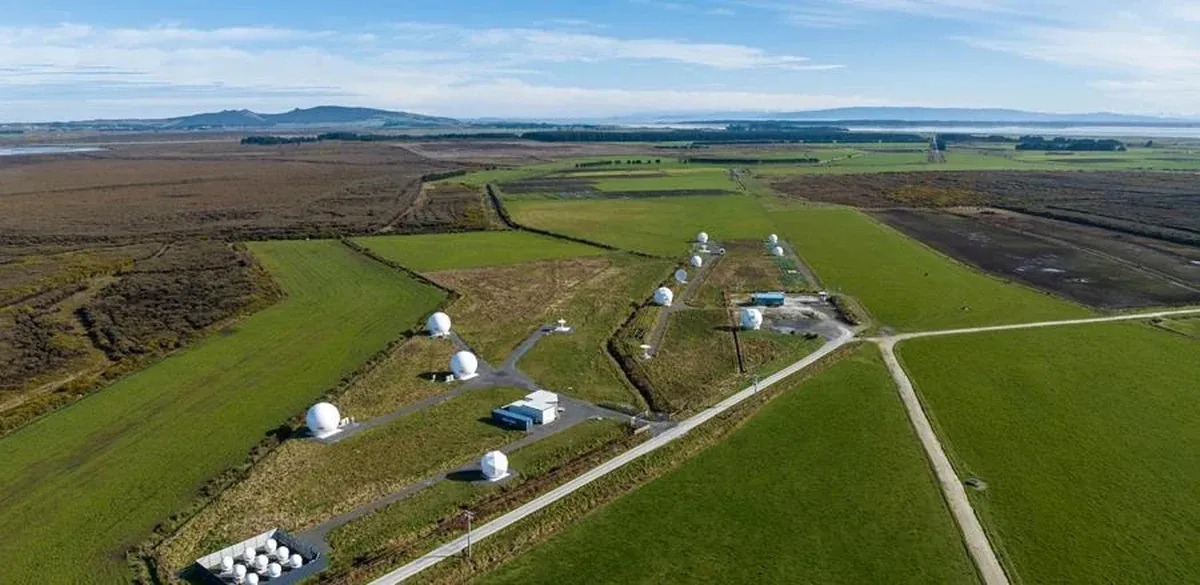
SpaceOps operates satellite ground stations at Bluff, south of Invercargill, and Warkworth, north of Auckland. Its primary business involves hosting antennas for spacecraft communications, serving major clients including defence giant Lockheed Martin, Norway's KSAT, and Italy's Leaf Space.
"We're globally important. We're very important for spacecraft that are in what's called 'low-earth orbit'," McNeill said.
The Bluff site hosts more than 30 large antennas, plus an assortment of smaller ones. Work there began in 2004 following a €200,000 (NZD$396,579) injection from the European Space Agency. The operation now covers 32 hectares funded entirely from company profits. SpaceOps employs 11 staff across both sites and is constructing a $4.55 million headquarters at Bluff. Turnover is forecast to reach about $5m this year.
Despite the commercial expansion, McNeill said addressing military work in the firm's statement of intent was "too hard."
"Policies are always tricky... I don't think it would affect how we operate, is the answer.
"I've got staff who would walk out on me if we went down a military route."
SpaceOps already undertakes contracts with defence ties. Under an agreement with Land Information New Zealand, the company locates the North and South Pole to within 1mm twice a week — data essential to satellites, including US military GPS. SpaceOps also partners with Lockheed Martin on the SouthPAN project; McNeill acknowledged the aerospace contractor creates satellite-based augmentation systems alongside fighter jets.
Commercial and defence boundaries are increasingly blurred, with McNeill noting many American and European spacecraft receive funding from both sectors, "and it's hard to know what happens."
The dilemma highlights growing international scrutiny around "dual-use" commercial space infrastructure, where civilian ground operations intersect with defence networks. Without a formal framework, responsibility falls to McNeill.
"It's not a problem. I don't want to have to go to prison," he said.
McNeill confirmed SpaceOps previously assisted with a covert security operation for the armed forces, though he noted civilian operations are rarely deemed secure enough by the military. Board discussions remained an option for "hairy" proposals, but had never been required.
Share this article
The link has been copied!
Your link has expired. Please request a new one.
Your link has expired. Please request a new one.
Your link has expired. Please request a new one.
Great! You've successfully signed up.
Great! You've successfully signed up.
Welcome back! You've successfully signed in.
Success! You now have access to additional content.