Southland Bucks National House Price Slump
Property news is presented by

Southland is holding up where most of the country isn't.
Seven months into 2026, the region has recorded a 3.1% increase in average home values — one of just three regions in positive territory nationally, alongside Canterbury (1.3%) and Otago (2.8%). Invercargill is up 0.1% and Gore has climbed 3.2%. Southland District is the exception, down 2.3%.
Nationally, the picture is grimmer. The QV House Price Index shows residential property values fell 1.5% in the three months to the end of July. The average New Zealand home is now worth $898,799 — down 1.3% since January and 1.2% lower than a year ago.
QV national spokesperson Simon Petersen said the winter slowdown had spread further than before. "The regional divide we highlighted last month is still evident, but there are fewer bright spots now. Winter has put a further chill through the market, while the prospect of higher borrowing costs and ongoing economic uncertainty have given buyers even less reason to rush."
Among the main centres, Wellington has taken the hardest hit, down 3.2% for the quarter. Auckland fell 2.2%. Christchurch managed a 0.3% gain — the only major city where values are still higher than at the start of the year. Tauranga (0.7%) has been quietly consistent across the North Island.
Petersen said Southland and Canterbury were benefiting from their own conditions rather than any broad national trend. "These markets are benefiting from their own mix of affordability, employment and supply-and-demand conditions. It's another reminder that there is no one-speed housing market in New Zealand right now, and conditions are not playing out evenly everywhere."
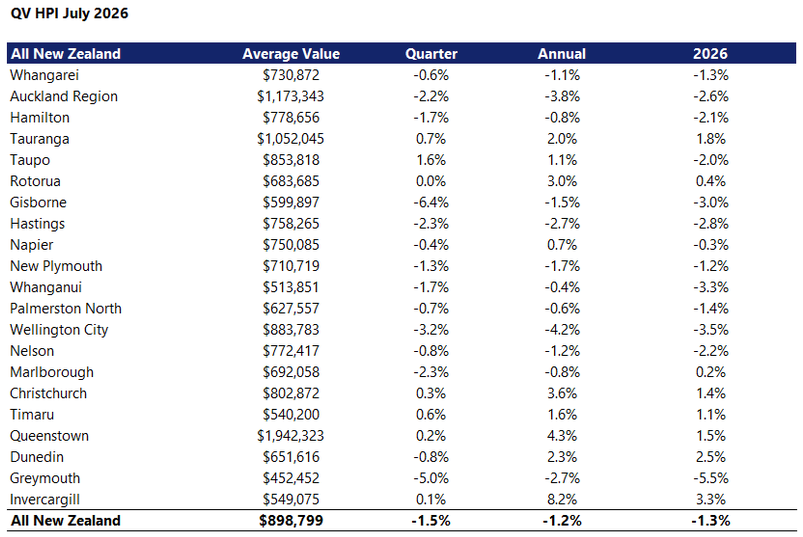
He was cautious about reading too much into sharp movements in smaller centres. "Markets such as Gisborne and Greymouth can fluctuate more sharply because fewer sales have a greater influence on the index. The longer-term trend is often more meaningful than any single quarterly result."
On the broader outlook, Petersen was measured but not optimistic. "This isn't another sudden correction. It's an already subdued market losing what little momentum it had built earlier in the year."
First-home buyers are still active, and well-priced homes are still selling — but urgency has largely evaporated. The general election later this year is doing little to encourage action. "Until that happens, we expect buyers to remain cautious and the market to continue moving at different speeds across the country."