
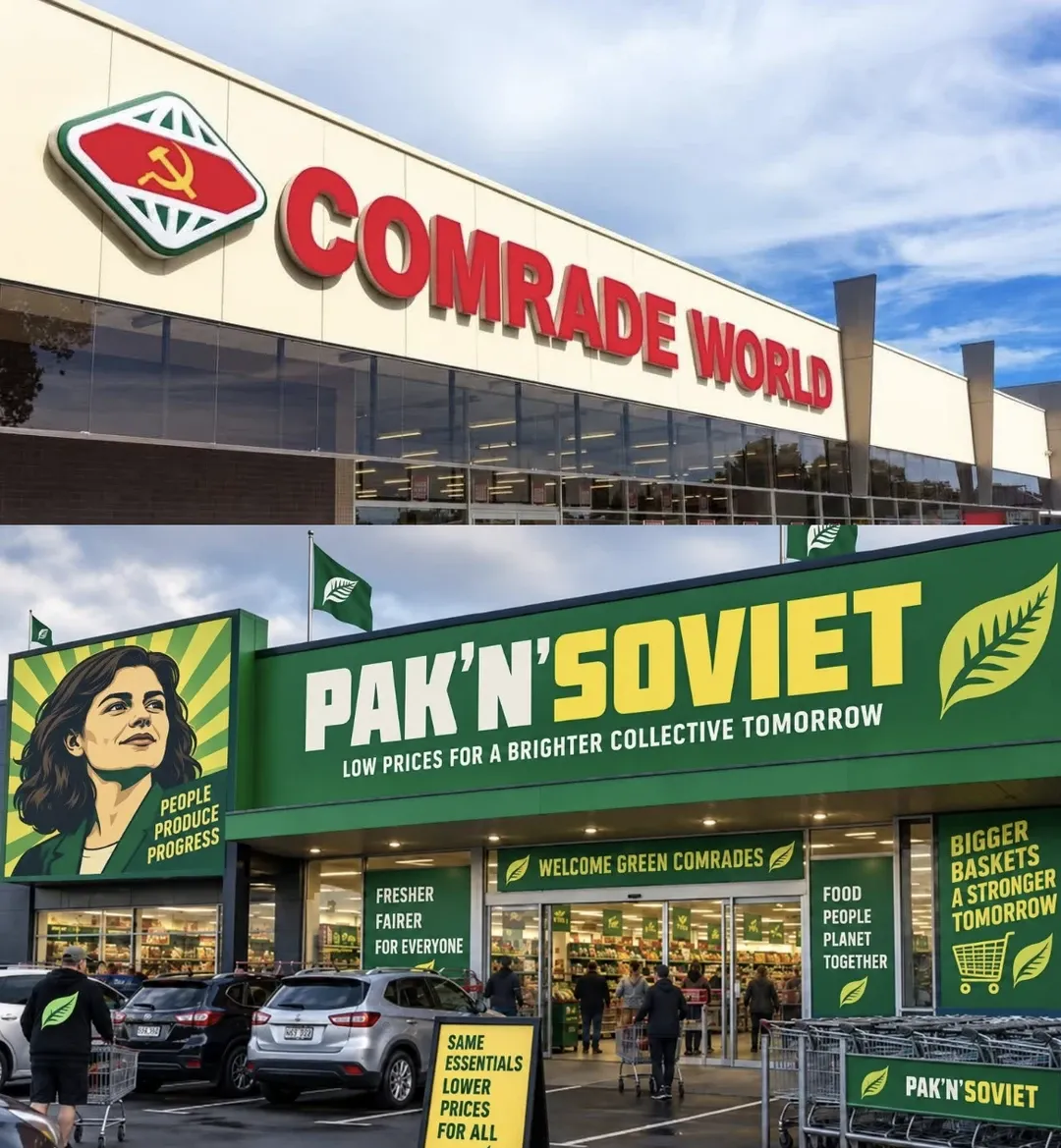
The Green Party wants to nationalise 120 supermarkets. The right thinks it's communism. The left thinks it's overdue. Everyone agrees the grocery duopoly is a problem — they just disagree on whether the cure is worse than the disease.
The policy, branded KiwiMart, would force Foodstuffs and Woolworths to sell 120 stores and two distribution centres into public ownership. New legislation would be required. The publicly owned chain would be mandated to prioritise affordability and would start with about 15 percent market share. Total cost: roughly $2.8 billion, split between $1.3 billion to acquire the stores and $1.5 billion to get the operation running.
Co-leader Chlöe Swarbrick says successive governments have tried and failed to lure an overseas competitor into the New Zealand market, leaving shoppers at the mercy of two players.
"That's why today we are announcing the real solution: a supermarket owned by all New Zealanders, for all New Zealanders," she said.
"We're not short of supermarkets, we're short of competition. As experts have noted, divestment — that is, buying already existing stores — is key to breaking up the duopoly."
Swarbrick pointed to support from economists and consumer advocates. "This is something that has been identified by experts and economists, the likes of Consumer New Zealand as a consumer advocacy group, who have identified that as a small country at the bottom of the world, that it does make sense to have a publicly owned supermarket as a third competitor," she said.
Co-leader Marama Davidson made the moral case. "Government has abdicated its responsibilities and left it to the market, in fact literally, the supermarket," she said, noting New Zealand produces enough food to feed 40 million people while people go without.
The reaction from the right was swift and unsparing.
New Zealand First leader Winston Peters called the policy "textbook communism by stealth," warning of Venezuelan-style queues and labelling the Greens "economic illiterates who think they are still in high school."
The Taxpayers' Union had a different complaint — the price tag doesn't add up. Executive Director Jordan Williams said the Parliamentary Library estimate used to justify the $1.3 billion acquisition cost "fails the most basic sniff test."
"Even if the two distribution centres are thrown in for free, it values each supermarket at just $10.8 million," Williams said. "PAK'nSAVE Albany's operating business was estimated at $50–60 million in 2021, excluding the land and building. New World Point Chevalier's owner reportedly paid $14 million for the fixtures and fittings alone."
"Apparently Chlöe Swarbrick can nationalise an entire supermarket for less than it costs another grocer to buy the shelves and fridges."
The Union is calling on the Speaker to intervene, arguing that using Parliamentary Library staff to cost a flagship election policy crosses a line. "Parliamentary resources are funded for parliamentary purposes. Electioneering is expressly excluded," Williams said. "If taxpayer-funded Library staff have been used to cost and bolster a flagship Green Party election policy, that is spending public money outside the purpose authorised by Parliament."
The Library's working assumptions have not been made public.
"Either the Parliamentary Library has found the bargain of the century, or something has gone badly wrong. It needs to release its workings and assumptions," Williams said.
Taxpayers' Union spokesperson Tory Relf was blunter still. "This is looking less like KiwiMart and more like CommieMart. Seizing firms' assets whether they want to sell or not will obviously send would-be investors running for the hills."
"New York is already heading down the same road: taxpayer-backed supermarkets undercutting local shops, while taxpayers are also being asked to open their wallets and subsidise the small businesses caught in the squeeze."
"Driving dairies and independent grocers out of business is a bizarre way to solve a competition problem."
The policy sits inside the Greens' broader 'Affordable Kai' platform, which includes expanding the school lunch programme and would cost more than $6 billion over four years.